We must explain to you how all seds this mistakens idea denouncing pleasures and praising account.
Are you ready to grow up your business? Contact Us
We must explain to you how all seds this mistakens idea denouncing pleasures and praising account.
State vs Central FSSAI License: Which One is Right for You? Choosing between a State FSSAI License and a Central FSSAI License depends on the scale and nature of your food business. The FSSAI License registration is mandatory for all food businesses in India, ensuring compliance with food safety standards. A State FSSAI License is required for food businesses with an annual turnover of ?12 lakh to ?20 crore, including small to medium-sized enterprises, manufacturers, traders, and distributors operating within a single state. You can easily apply for State Food License Registration online through the FSSAI portal. On the other hand, a Central FSSAI License is necessary for businesses with a turnover above ?20 crore, operating in multiple states, or engaged in food import/export, large-scale manufacturing, or e-commerce food services like Zomato and Swiggy. To apply for an FSSAI License online, visit the FSSAI registration portal, fill out the application, and submit the necessary FSSAI documents. Timely FSSAI license renewal is crucial to avoid penalties and maintain compliance. Whether you need a State FSSAI License or a Central FSSAI License, our FSSAI consultants ensure a smooth, hassle-free process for your food business registration.


Call our Best Experienced Consultants
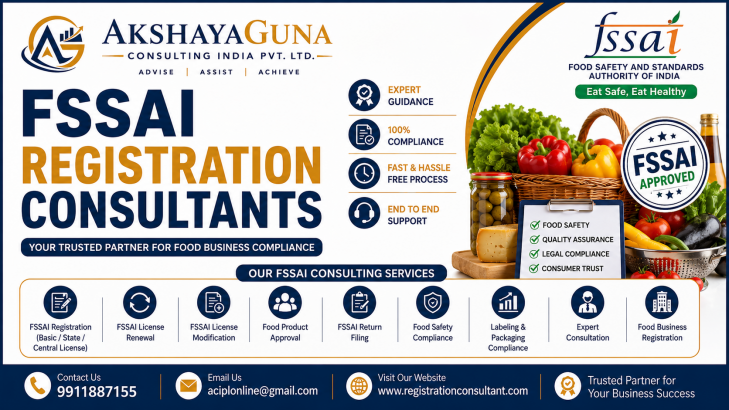
Securing an FSSAI registration or food license online is a mandatory statutory prerequisite for any food business operator (FBO) involved in the manufacturing, processing, storage, distribution, sale, or import of food products across India. Regulated under the Food Safety and Standards Act, 2006, this certification issues a unique 14-digit FSSAI license number that ensures complete alignment with national health, quality, and hygiene benchmarks. At Akshayaguna Consulting India Pvt. Ltd., we deliver expert-backed advisory and end-to-end processing services to simplify your FSSAI license registration India journey from start to finish. To accommodate varying operational scales, the Food Safety and Standards Authority of India (FSSAI) implements a tiered licensing structure: FSSAI Basic Registration (Form A): Target Audience: Petty food manufacturers, small-scale vendors, hawkers, home bakers, temporary stall holders, tiffin services, and cloud kitchens with an annual turnover of up to ?12 Lakh. FSSAI State License (Form B): Target Audience: Medium-scale enterprises, including standalone restaurants, hotel chains, mid-size manufacturing units, storage houses, and distributors operating within a single state, with an annual turnover ranging between ?12 Lakh and ?20 Crore. FSSAI Central License (Form B): Target Audience: Large-scale manufacturers, 100% export-oriented units (EOUs), multi-state operators, food importers/exporters, e-commerce food aggregators, and businesses with an annual turnover exceeding ?20 Crore. Accurate paperwork prevents administrative scrutiny or delays during digital processing on the FoSCoS (Food Safety Compliance System) portal. The requirements are categorized by application tier: Apex Regulatory Authority: The Food Safety and Standards Authority of India (FSSAI), operating under the administrative umbrella of the Ministry of Health and Family Welfare, Government of India. Digital Infrastructure: All applications, renewals, and modifications are executed seamlessly via the centralized FoSCoS portal, administered in coordination with state-level food safety commissioners. At Akshayaguna Consulting India Pvt. Ltd., our compliance specialists manage your FSSAI registration online, documentation structuring, and regulatory filings with precision, enabling your business to operate legally, build consumer trust, and scale confidently across India. Operating any form of commercial food enterprise in the nation requires mandatory authorization governed under the apex regulatory framework of the Food Safety and Standards Authority of India. Obtaining a formal FSSAI certification acts as a legal prerequisite for manufacturers, processors, distributors, traders, cloud kitchens, and retailers. At Akshayaguna Consulting India Pvt. Ltd., our specialized advisory teams assist food business operators through every stage of regulatory compliance, ensuring seamless navigation of statutory standards. Securing an authentic FSSAI Registration guarantees that your enterprise complies with national health, hygiene, and safety parameters established by the government. The integration of digital workflows has simplified the path to acquiring an official FSSAI License through centralized government web portals, eliminating traditional administrative hurdles. Partnering with an experienced FSSAI Registration Consultant ensures precision during application drafting, category selection, and document verification. Managing an error-free FSSAI License Registration safeguards companies against sudden operational halts, penalties, or product seizures enforced by food safety officers. Executing a streamlined FSSAI Registration India project establishes immediate corporate credibility, enabling businesses to scale operations safely across state borders and retail networks. Securing a trusted FSSAI License India credential builds long-term consumer trust, which remains vital for modern food brands operating in competitive consumer markets. Every food enterprise must display its unique 14-digit registration code on product packaging, marketing assets, and invoice documentation to assure buyers of product traceability. Opting for a professional FSSAI Consultant helps founders correctly interpret evolving statutory amendments, turnover thresholds, and inspection guidelines without friction. Initiating a formal Food License requires a comprehensive evaluation of operational capacities, product lines, and annual turnover brackets. Securing a valid Food License Registration gives food business operators the legal right to manufacture, store, distribute, and sell edible items to the public. Leveraging digitized pathways for Food License Online procedures accelerates processing times and provides real-time status tracking via automated government portals. Small-scale operators, home bakers, tiffin services, and petty retailers typically apply for an FSSAI Basic Registration if their annual financial turnover falls within the baseline limit of Rs.1.5 crore. Growing medium-scale enterprises, restaurant chains, and regional distributors must transition toward securing an FSSAI State License to match their expanded commercial footprints. Large-scale manufacturers, multi-state corporate entities, food importers, and e-commerce aggregators are legally bound to obtain an FSSAI Central License regardless of initial turnover parameters. Navigating routine FSSAI Renewal protocols is essential for maintaining active corporate standing, though recent regulatory updates have introduced perpetual validity frameworks coupled with mandatory annual fee submissions. Managing timely FSSAI License Renewal workflows prevents unexpected status suspensions and ensures uninterrupted business operations. Utilizing specialized FSSAI Registration Services allows entrepreneurs to delegate complex paperwork while focusing entirely on product quality and market expansion. Engaging a dedicated FSSAI License Consultant guarantees that technical layouts, water testing reports, and safety management blueprints meet official scrutiny standards. Submitting a comprehensive FSSAI Application requires meticulous attention to detail, matching exact business activities with official Kind of Business (KoB) classifications. Understanding the step-by-step FSSAI Registration Process minimizes query responses and fast-tracks certificate generation by designated food safety authorities. Compiling the correct FSSAI Documents Required—such as identity proofs, premises ownership agreements, machinery lists, and blueprint layouts—prevents avoidable application rejections. Reviewing the applicable FSSAI Registration Fees ensures timely payment according to the chosen category, whether utilizing basic tiers or concessional schedules. Conducting periodic FSSAI License Verification protects supply chains from fraudulent operators and verifies the active legal status of partner vendors. Acquiring an official FSSAI Food License acts as a foundational asset for establishing commercial partnerships with major delivery aggregators and supermarket chains. Maintaining strict ongoing FSSAI Compliance safeguards organizations against routine audits, surveillance findings, and risk-based inspection penalties. Businesses seeking localized expertise in the capital region often partner with specialized teams handling FSSAI Registration Delhi portfolios to expedite regional licensing workflows. Collaborating with an established FSSAI Consultant Delhi professional bridges the gap between complex municipal regulations and central food safety statutes. Retaining a qualified FSSAI License Consultant India ensures that multi-branch operations and national supply chains maintain uniform regulatory alignment across every operating territory. At Akshayaguna Consulting India Pvt. Ltd., our compliance experts remain dedicated to delivering transparent, efficient, and reliable statutory advisory services for all food sector enterprises. |
Your Trusted Partner

Copyrights@ 2017 Akshyaguna Consulting India Pvt. Ltd.(ACIPL)